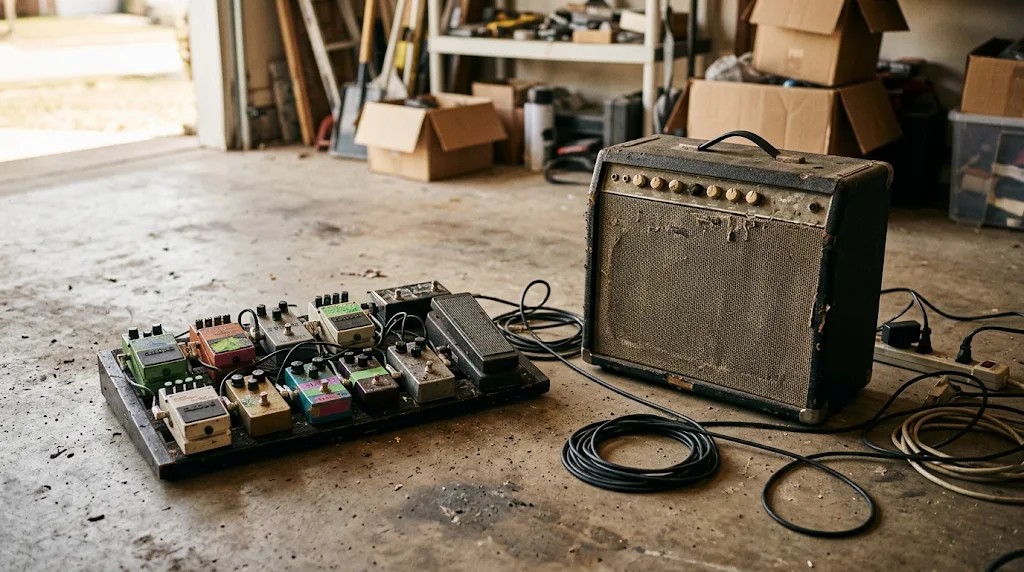
Let me tell you about my guitar rig. Not the dream rig — the actual one, the one that has played real gigs in front of real people who paid real money.
Guitar: bought used, $800. Amp: a workhorse combo, $600 used. Pedalboard: tuner, overdrive, delay, wah — call it $400 total, half of it bought off other musicians who were "upgrading" (their loss). Cables, strings, picks: maybe $150 a year. Total capital outlay: roughly two grand. Annual upkeep: under $200.
That rig has earned me more joy per dollar than any business investment I've ever made. And here's the part that should bother you: it costs less per year than the average small company's forgotten SaaS subscriptions.
The Pedalboard Principle
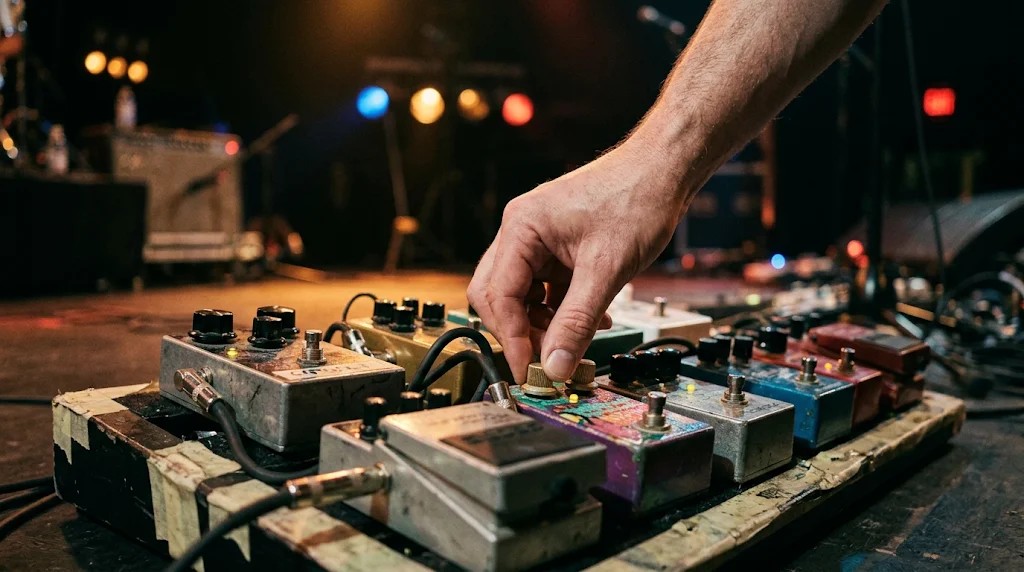
Every guitarist learns this the hard way. You start with one overdrive pedal. Then you "need" a chorus. Then a phaser. Then a looper you'll use twice. Within a year your pedalboard looks like mission control and your tone sounds like soup.
The cure is the pedalboard principle: every pedal has to earn its place, every gig. If I stomp it less than once a set, it comes off the board. No sentimentality. The pedal doesn't care about my feelings, and my back thanks me at load-out.
Now apply that to your SaaS stack. When's the last time someone audited which apps your team actually opens? I did this exercise with a 50-person company last year. They were paying for 87 subscriptions. Active usage: 41. The other 46 were zombie apps — $2,100 a month, $25,000 a year, paying rent on software nobody remembered buying. One of them was a project management tool they'd replaced eighteen months earlier. Eighteen months of paying for the ex.
The Soundcheck Test
Before every gig, I soundcheck. Not because I don't trust my gear — because rooms are different and things drift. A knob gets bumped in transit. A tube gets tired. You check, you adjust, you play.
Businesses never soundcheck their software. They buy it, onboard half the team, and let it drift for three years. Here's my soundcheck, and you can run it this week:
- Pull the credit card statement. Not the IT inventory — the money. Every recurring charge under $200/month is where the zombies hide, because nobody approves them twice.
- Ask three people what they actually use. Not what they're "supposed" to use. What they open on a Tuesday.
- Kill one thing this week. Just one. The app with three logins and zero advocates. You'll feel nothing, and you'll save $1,200 a year.
A guitarist who won't drop a dead pedal ends up with back pain and bad tone. A company that won't kill a dead app ends up with a $30k/year museum of good intentions.

What the Rig Taught Me About Buying ERP
This is the part where the music thing stops being a metaphor and starts being my actual job. When I sell ERP — SAP Business One, Odoo, whatever fits — the pitch is never "buy more software." It's "replace twelve things with one thing."
My rig is one guitar, one amp, four pedals. It does everything I need because every piece was chosen for a reason. That's what a good ERP implementation feels like: fewer logins, fewer subscriptions, one system where the left hand knows what the right hand invoiced.
The companies drowning in SaaS sprawl are the ones who buy software like I used to buy pedals — one shiny thing at a time, no plan, no board. Then they call me, and we spend the first month just figuring out what they own.
The Encore
I'm not saying cancel everything and go acoustic. Some software earns its keep — my CRM, my accounting, the tools my team touches daily. Those are the guitar and the amp. Everything else has to pass the stomp test.
Tonight, go look at your subscriptions the way I'd look at a pedalboard. If you wouldn't bend down mid-song to step on it, sell it.
David Strausser, Dead Brands LLC / Quaint Business Solutions Want help with your ERP? Book a call — first thing we'll do is find the software you're paying for and not using. Deadbrands.co merch is live — including the shirt that says exactly what your CFO is thinking.
Image Prompts
- HERO: Lo-fi film-grain photo of a well-worn pedalboard on a stage floor — four pedals, visible wear, cable snakes, warm stage light from the side, candid gig-photo aesthetic, slightly tilted framing.
- BODY: A laptop screen showing a chaotic grid of colorful SaaS app icons next to a simple guitar leaning against the desk — visual contrast, casual snapshot, Portra-style color.
- BODY: Close-up of a hand stomping an overdrive pedal mid-gig, motion energy, grainy black-and-white 35mm, sweat and stage lights.
Frequently asked questions
How much does David's guitar rig actually cost?
Roughly two grand in capital, almost all of it bought used: an $800 guitar, a $600 workhorse amp, about $400 of pedals, and under $200 a year in strings, cables, and upkeep. That rig has played real gigs in front of real people who paid real money.
How does that compare to a small company's SaaS stack?
The average small business pays for 100-plus SaaS apps while finance only knows about 60 of them — tens of thousands a year producing login screens nobody opens. The rig runs on $200 a year and produces music. Every ERP engagement starts with the same audit: find the software you are paying for and not using.
What is the Pedalboard Principle?
Every piece of gear has to earn its spot on the board, or it gets sold. Musicians learn it early because board space is finite and their own money is on the line. Apply the same discipline to software: if a subscription cannot justify its seat in one sentence, cancel it.
How do you audit a SaaS stack for waste?
Start with the billing statements, not the IT inventory — the charges never lie. List every recurring software charge, match each one to an owner and a last-used date, and make every app re-justify itself. The forgotten subscriptions you find usually pay for the audit several times over.