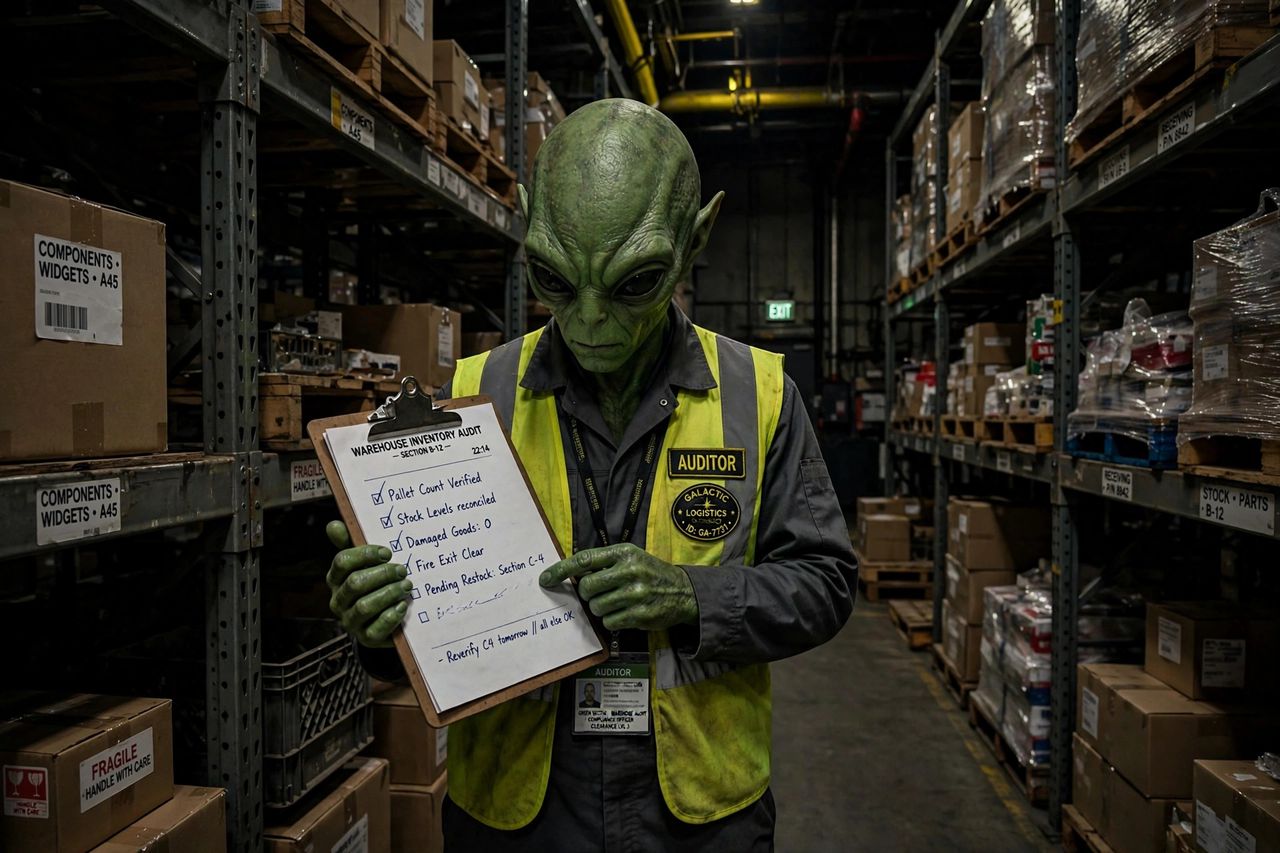

Executive Summary
This is a silly premise with a serious point. Your ERP is supposed to be the single source of truth about your business. But for most companies, it's more like a single source of approximately the truth, filtered through three years of workarounds and "we'll fix that later." An alien auditor wouldn't need advanced technology to find the problems. They'd just need read access.
The inventory that isn't there
The aliens beam down into your warehouse and scan the shelves. Their instruments say 400 units. Your ERP says 650. The spreadsheet on the warehouse manager's desktop says "about 500???" with three question marks.
This is the first thing any ERP consultant checks, and it's the thing most businesses get wrong: inventory accuracy. If your system doesn't match reality, every downstream number — available-to-promise, reorder points, cost of goods sold, the valuation on your balance sheet — is fiction. The aliens don't need to probe your minds. They just need to count your widgets.
The fix isn't exotic technology. It's cycle counting: a little bit, every day, forever. Count 20 SKUs a day and you'll audit your entire warehouse every quarter without shutting down. The companies that do this have inventory accuracy above 95%. The ones that don't are running on vibes.
!A UFO tractor beam scanning warehouse shelves while a worker checks a tablet
The customer who exists three times
The aliens pull up your customer list. They find "Acme Corp," "ACME Corp.," and "Acme Corporation" — three records, three different addresses, two different phone numbers, one actual customer. Their universal translator short-circuits trying to figure out if this is one entity or a shell-company scheme.
Duplicate master data is the silent killer of ERP value. Every duplicate customer, vendor, or product multiplies confusion: which record has the right credit limit? Which one has the open orders? When sales runs a report, which version of the truth do they get?
Odoo actually has decent duplicate detection if you turn it on, but most implementations skip it during setup because "we'll clean the data later." Later never comes. The aliens are judging you.
The process only Carol understands
The aliens ask how an order gets from quote to cash. You show them the ERP workflow. Then Carol leans over and whispers, "Oh, but for that customer we do it differently — I have a spreadsheet." The aliens exchange a look. They've seen this before. On seventeen planets.
Tribal knowledge is the enemy of every ERP implementation. If a critical business process lives in one person's head — or one person's spreadsheet — you don't have a system, you have a single point of failure with a coffee mug. The ERP is supposed to be the process. Every "but we do it differently for them" is a workaround that should either become a configured rule or be eliminated.
This isn't about Carol. Carol is great. It's about the fact that if Carol wins the lottery tomorrow, your order-to-cash process leaves with her.
The report nobody believes
The aliens ask for a sales report. You generate it from the ERP. Your sales manager looks at it, laughs, and opens their spreadsheet — "the real numbers." The aliens conclude that humans have invented a machine for generating numbers that nobody trusts, which is arguably more advanced than warp drive.
If people don't trust the ERP data, they'll build shadow systems. Shadow systems create conflicting numbers. Conflicting numbers create arguments. Arguments create meetings. Meetings create... well, you know.
The root cause is almost always data entry discipline, not software. If half the opportunities never get updated, the pipeline report is fiction. If inventory adjustments happen without documentation, the stock report is fiction. The ERP is a mirror — it reflects the discipline you put into it.
The backup from the before times
The aliens ask about disaster recovery. You proudly show them the backup system. They check the timestamp. The last successful test restore was... never. The backups exist. Whether they work is a matter of faith.
This one isn't funny. Untested backups are the same as no backups. Every IT person knows this. Almost nobody does the drill. Schedule a test restore twice a year. It takes an afternoon. The alternative takes a business.
The bottom line
Here's the thing the aliens would figure out in about twenty minutes: the technology was never the problem. Odoo, SAP Business One, NetSuite, whatever you run — they're all capable of being a genuine single source of truth. The gap between "capable" and "actual" is always human: the counting that didn't happen, the duplicates nobody merged, the process that stayed in Carol's head, the backup nobody tested.
You don't need alien technology to fix any of this. You need a Saturday morning, a pot of coffee, and the willingness to look at what your system actually says versus what's actually true. The aliens would respect that. Probably.
And if they don't — well, at least your inventory will be accurate when they conquer us.
Penny is the weekend voice of the Dead Brands blog — practical business wisdom with a sense of humor, brought to you by Dead Brands, LLC. David Strausser helps small and mid-sized businesses implement Odoo and SAP Business One. Book a meeting to talk about your ERP project.
🛍️ Merch plug: preparing for first contact in style — It's Raining Like Hell (Still Here), Rain Check: Denied, Generals: 20% Off, and The Drones Got the Four-Star.